
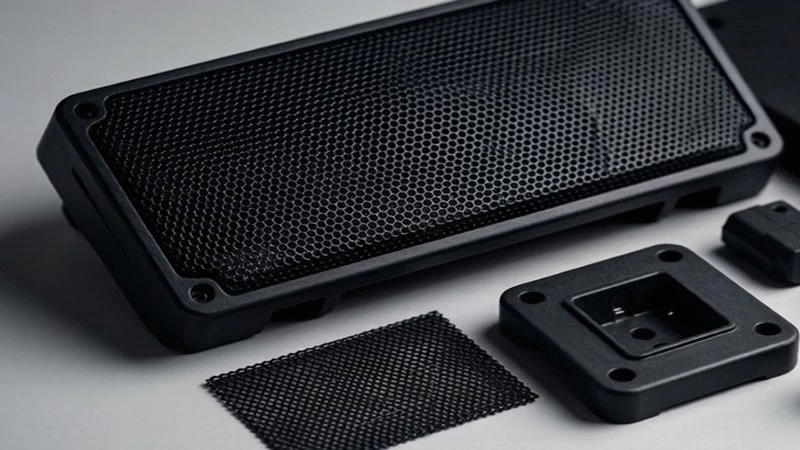
Speaker Grille and Audio Component Plastic Molding
In This Guide
Speaker Grille Design Considerations
A speaker grille must balance acoustic transparency with structural integrity and appearance. Key design factors:
- Open area ratio — typically 30–60% for adequate sound passage
- Hole pattern — round, slot, or custom geometry
- Hole size — small enough to protect the driver, large enough for sound
- Wall thickness — thin enough for acoustic transparency, thick enough for strength
- Surface finish — matte or textured to reduce visual reflection
Material Selection for Audio Parts
Audio components use materials that balance acoustic properties, appearance, and durability:
| Component | Common Material | Key Property |
|---|---|---|
| Speaker grille | ABS or PC | Stiffness, moldability for mesh |
| Speaker housing | ABS or PC/ABS | Rigidity, acoustic damping |
| Internal bracket | PA or POM | Mechanical strength, precision |
| Decorative trim | ABS (plated) | Metallic appearance |
Molding Challenges for Grilles
Speaker grilles present specific molding challenges due to their perforated geometry:
- Thin walls between holes require high flow length ratio
- Hole patterns create many flow obstructions and weld lines
- Gate location must distribute material evenly across the grille
- Ejection must not deform thin sections between holes
Grille open area and hole pattern affect both acoustics and moldability. A supplier with audio component experience can recommend designs that balance sound performance with production feasibility.
Dimensional Tolerance for Audio Assembly
Audio components must fit precisely into speaker cabinets or mounting frames. Tolerance requirements:
- Grille outer dimensions: ±0.2 mm for cabinet fit
- Mounting boss positions: ±0.15 mm
- Hole diameter: ±0.05 mm for consistent appearance
- Flatness: critical for grille-to-cabinet contact
Surface Finish for Visible Audio Parts
Speaker grilles are often visible components. Surface finish options:
| Finish | Appearance | Application |
|---|---|---|
| Matte texture | Non-reflective, fingerprint resistant | Front grilles |
| Painted | Custom color match | Branded speaker lines |
| Plated | Metallic chrome look | Premium decorative trim |
| Soft-touch | Tactile feel | Control knobs, grips |
Hengmei Plastic Products molds audio equipment components including speaker grilles, housings, and internal parts. Confirm acoustic and appearance requirements during quoting.
Quality Control for Audio Components
Audio part inspection goes beyond dimensions:
- Open area measurement — verify acoustic transparency
- Hole pattern uniformity — visual and dimensional check
- Surface finish consistency — gloss or texture match
- Assembly fit test — confirm grille fits cabinet without gaps
Frequently Asked Questions
What open area ratio should a speaker grille have?
Typically 30–60%, depending on the driver size and acoustic requirements. Higher open area improves sound passage but reduces structural strength. Confirm the target ratio with your acoustic engineer.
Can I mold a grille with very small holes?
Yes, but small holes (under 1 mm) require precise mold making and may limit flow. Very fine patterns may need EDM or specialized mold making. Discuss feasibility with the supplier.
What material is best for speaker housings?
ABS and PC/ABS are common for housings due to rigidity and acoustic damping. For premium speakers, PC provides higher impact resistance. Confirm material with your acoustic requirements.
Can the grille be painted to match a brand color?
Yes. Painting applies custom colors to grilles. Confirm paint adhesion and durability testing. Texture may affect paint appearance — test samples before approval.
Key Takeaways
Speaker grilles and audio components require balancing acoustic performance with appearance and moldability. Specify open area ratio, hole pattern, material, and dimensional tolerance. Choose surface finish based on visibility and brand requirements. Work with a supplier experienced in audio component molding for consistent quality.
Discuss Your Audio Component Project
Send your speaker component specifications for a manufacturing assessment.
To get an accurate quote, include these details in your inquiry:
- Grille dimensions and hole pattern
- Material preference
- Open area ratio target
- Surface finish
- Annual volume
- Acoustic requirements
Send your specifications to Hengmei Plastic Products and receive a tailored quotation.