Common Defects in Injection-Molded Parts and How to Avoid Them
In This Guide
Short Shot
A short shot occurs when the mold does not fill completely. The part is missing material, often at the end of flow or in thin sections.
| Cause | Solution |
|---|---|
| Insufficient injection pressure | Increase pressure within machine limit |
| Low melt or mold temperature | Raise temperature, confirm heater function |
| Inadequate venting | Add vents at flow ends |
| Wall too thin for flow length | Redesign wall or add flow leader |
Flash
Flash is excess material that escapes at the parting line, ejector pins, or slides. It appears as thin fins of plastic on the part edge.
| Cause | Solution |
|---|---|
| Insufficient clamping force | Use larger tonnage machine |
| Worn parting line | Repair mold, re-machine parting surface |
| Excessive injection pressure | Reduce pressure or speed |
| Mold damage or misalignment | Realign and repair mold |
Sink Marks
Sink marks are depressions on the part surface, typically above thick sections like ribs or bosses. They occur when the outer skin contracts as the core cools and shrinks.
- Reduce wall thickness in thick areas
- Core out thick sections to create uniform walls
- Reduce rib thickness to 50–60 percent of adjoining wall
- Increase packing pressure and time
- Move gate closer to thick section
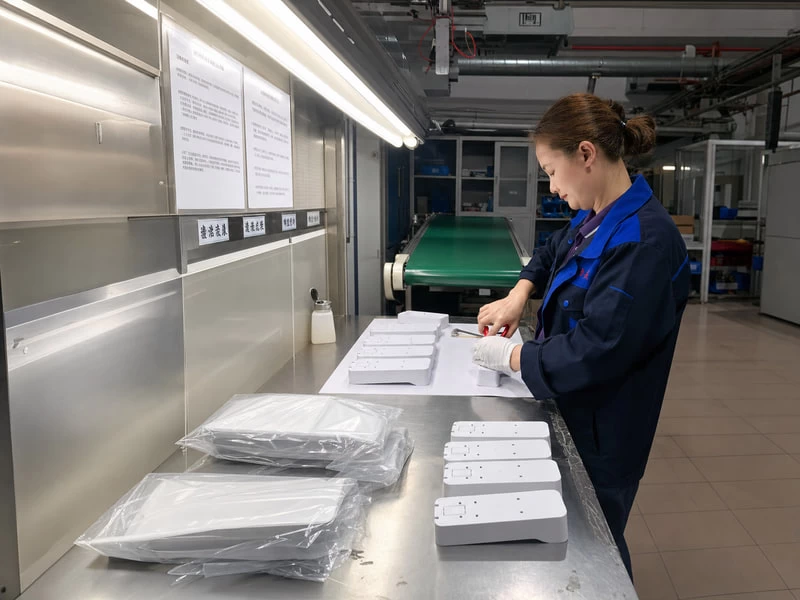
Finishing and inspection — defect detection during production
Warp (Warpage)
Warp is dimensional distortion caused by uneven cooling and differential shrinkage. Parts twist or bow instead of staying flat. Prevention focuses on uniform cooling:
- Maintain uniform wall thickness throughout the part
- Design cooling channels for even temperature distribution
- Use glass-filled material for lower shrinkage
- Adjust mold temperature differentially if needed
- Allow adequate cooling time before ejection
Weld Lines (Knit Lines)
Weld lines form where two flow fronts meet. They appear as visible lines and can be weak points in the part. To minimize weld line impact:
- Relocate gates to change flow pattern
- Increase melt and mold temperature
- Add flow channels to move weld line to non-critical area
- Increase injection speed
Burn Marks
Burn marks are black or discolored streaks caused by trapped air or gas igniting under compression. They indicate inadequate venting.
| Cause | Solution |
|---|---|
| Trapped air | Add or clean vents at flow ends |
| Excessive injection speed | Reduce speed, especially near fill completion |
| Degraded material | Lower barrel temperature, purge material |
Working with Your Supplier on Defects
When defects appear in samples or production, communicate clearly with the supplier. Provide photos, dimensional data, and batch information. A capable supplier will investigate root cause and propose corrective action. Document the issue and resolution for future reference.
Hengmei Plastic Products conducts in-process inspection and optical measurement to detect defects early. Discuss defect tolerance and corrective action procedures during quoting.
Frequently Asked Questions
Are some defects acceptable?
It depends on the part. Cosmetic defects may be acceptable on non-visible surfaces. Functional defects (short shots, weak weld lines) are rarely acceptable. Define defect tolerance in your specification and AQL.
Who pays for defective parts?
Responsibility depends on the cause. If the mold or process is at fault, the supplier typically replaces the parts. If the design causes the defect (e.g., impossible wall thickness), the buyer funds the fix. Clarify in your quality agreement.
Can defects be fixed without changing the mold?
Some defects (short shot, flash) can be adjusted through process parameters. Others (sink in thick sections, warp from uneven walls) require mold modification. Your supplier will advise after inspection.
How do I prevent defects in transparent parts?
Transparent PC and PMMA parts are sensitive to burn marks, weld lines, and sink. Require careful mold polishing, adequate venting, and optimized process parameters. Plan for slower cycles to ensure quality.
Key Takeaways
Injection molding defects have identifiable causes and solutions. Short shots, flash, sink marks, warp, weld lines, and burn marks each respond to specific mold, process, or design changes. Define defect tolerance upfront, communicate with your supplier, and document corrective actions to prevent recurrence.
Discuss Defect Prevention
Share your part design and quality requirements for a defect-prevention plan.
To get an accurate quote, include these details in your inquiry:
- Part drawings
- Material
- Critical dimensions and tolerances
- Surface finish requirements
- Defect tolerance
- AQL standard
Send your specifications to Hengmei Plastic Products and receive a tailored quotation.