
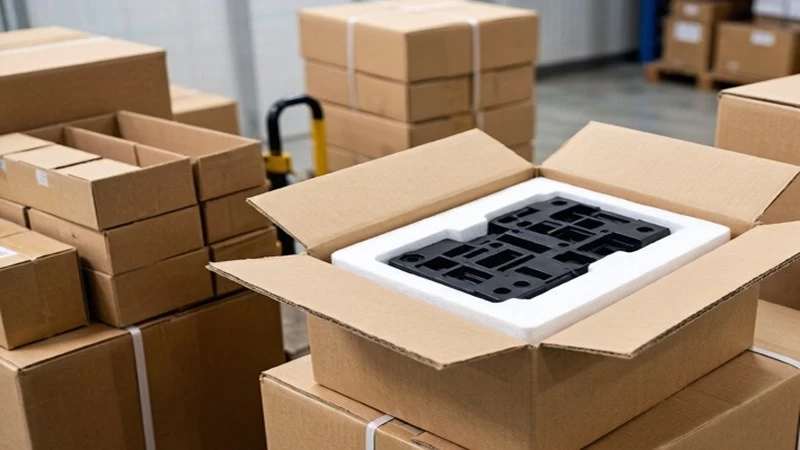
Packaging and Shipping Plastic Parts from China to the US
In This Guide
Export Packaging Options
Plastic parts vary in fragility, size, and surface finish requirements. Match the packaging to the product:
| Packaging Type | Best For | Cost Impact |
|---|---|---|
| Bulk poly bag | Non-visible parts, bulk hardware | Lowest |
| Individual poly bag | Visible surface parts | Low |
| Partition carton | Painted or glossy parts | Medium |
| Blister or tray | High-value, fragile parts | Medium-High |
| Returnable container | Automotive, recurring programs | High upfront, low per-trip |
Carton and Pallet Standards
Export cartons should withstand container shipping without collapse. Standard export carton burst strength is 12 to 18 kg/cm². Pallets should be heat-treated (ISPM-15) for US entry. Confirm carton dimensions fit standard pallets (48" x 40" or 1200 x 1000 mm) to maximize container utilization.
Ocean Freight: The Cost-Effective Default
For most plastic parts, ocean freight is the economical choice. Typical transit times:
| Route | Transit Time | Notes |
|---|---|---|
| Shenzhen/Yantian to Los Angeles | 14–20 days | Fastest US west coast route |
| Shenzhen to Long Beach | 15–22 days | Common west coast destination |
| Shenzhen to New York (via Panama) | 28–35 days | East coast via canal |
| Shenzhen to Houston | 28–35 days | Gulf coast service |
Add 5 to 7 days for port handling, customs clearance, and inland delivery to your warehouse. Total door-to-door lead time typically runs 25 to 45 days depending on destination.
Air Freight: For Urgent or High-Value Shipments
Air freight costs 5 to 10 times ocean freight but delivers in 3 to 7 days door-to-door. Use air freight for urgent samples, small high-value shipments, or production line-down emergencies. Minimum chargeable weight is typically 45 kg.
Incoterms: FOB vs EXW vs DDP
The Incoterm defines who arranges and pays for shipping, insurance, and customs. Common terms for China-to-US shipments:
- FOB (Free on Board): Supplier delivers to the port, buyer arranges freight and customs. Most common for experienced importers.
- EXW (Ex Works): Buyer arranges everything from the supplier's factory. Maximum control, more logistics work.
- DDP (Delivered Duty Paid): Supplier delivers to buyer's door with duties paid. Simplest for buyer, but verify the supplier's US customs broker capability.
US Customs Documentation
For US entry, the importer needs commercial documents. Your customs broker can prepare the entry, but you must provide:
- Commercial invoice with HS code and country of origin
- Packing list with weights and dimensions
- Bill of lading (ocean) or air waybill (air)
- Material compliance documentation if applicable
Hengmei Plastic Products packs export shipments with ISPM-15 pallets and provides commercial invoices, packing lists, and product photos for customs clearance.
Managing Lead Time Risk
Build buffer into your supply chain. Ocean freight schedules can shift due to port congestion or weather. Maintain safety stock of 4 to 8 weeks for critical components, and identify backup freight routes during peak season (August to October).
Frequently Asked Questions
What is the cheapest way to ship plastic parts from China?
Ocean freight in full containers (FCL) is the lowest per-unit cost. LCL (less than container load) works for smaller volumes but costs more per cubic meter. For shipments under 100 kg, air freight may be comparable.
Do I need a customs broker?
Yes, for formal US entries valued over $2,500. A customs broker files the entry, calculates duties, and coordinates with CBP. Many freight forwarders offer brokerage services.
What HS code applies to plastic parts?
HS codes depend on the product type. Injection-molded plastic articles often fall under Chapter 39. Confirm the specific 10-digit HTS code with your customs broker, as it affects duty rate.
How do I prevent damage during shipping?
Use appropriate packaging — partition cartons for visible surfaces, bubble wrap for fragile parts, and corner protectors for cartons. Request photos of packed pallets before shipment. Insurance covers transit damage.
What is the typical duty rate for plastic parts from China?
Duty rates vary by HTS code, typically 0 to 6.5 percent for most plastic articles under Chapter 39. Some products face Section 301 tariffs (currently 7.5 to 25 percent). Confirm current rates with your customs broker.
Key Takeaways
Export logistics for plastic parts involves choosing the right packaging, freight mode, and Incoterm. Ocean freight is the cost-effective default with 25 to 45 day door-to-door lead time. Work with a customs broker, maintain safety stock, and build buffer into your timeline for peak season and port congestion.
Plan Your Shipment
Share your product and destination for packaging and logistics recommendations.
To get an accurate quote, include these details in your inquiry:
- Product type and fragility
- Shipment volume and weight
- Destination port or ZIP
- Preferred Incoterm
- Target delivery date
- Customs broker status
Send your specifications to Hengmei Plastic Products and receive a tailored quotation.