
Mold Steel Selection for Injection Molds: Hardness, Conductivity and Service Life Trade-offs
- Why steel choice drives total cost, not just tooling cost
- The four steel families and what each is actually for
- Five application variables that decide the grade
- Selection matrix by application and volume
- Hardness, conductivity and toughness: the real trade-off curve
- Common specification mistakes
- How to verify steel claims on a quotation
Why steel choice drives total cost, not just tooling cost
Buyers comparing mold quotations usually compare one number. That number — the tooling price — is the smallest part of the story. The steel grade determines three downstream costs that are frequently larger than the mold itself.
The first is cycle time. Steel with higher thermal conductivity pulls heat out of the melt faster, which shortens cooling time. Cooling typically represents 50–70% of the total injection cycle. A grade that is 20% slower to conduct heat can add several seconds per shot; across a 300,000-shot program, that is hundreds of production hours.
The second is maintenance frequency. Softer steel wears at gate areas, parting lines and sliding surfaces. Each wear event means production stops, the mold is pulled, and repaired — then the first shots after repair must be inspected for dimensional drift. Wear rate therefore sets unplanned downtime.
The third is total mold life. A mold that survives 100,000 shots and then needs replacement costs more across a five-year program than a more expensive mold that survives 500,000. This is why life-cycle cost, not purchase price, is the correct comparison metric.
Rule of thumb: when annual volume exceeds roughly 20,000 pieces and the product has a multi-year life, the incremental cost of one steel grade higher is almost always recovered inside the first production year.
The four steel families and what each is actually for
P20 / 1.2311 — pre-hardened, general purpose
Supplied at roughly 28–34 HRC, P20-class steel requires no post-machining heat treatment, which keeps lead time short and avoids distortion risk. It machines well and polishes to a serviceable finish. It is the default for housings, brackets, covers and internal structural parts where volumes sit in the tens to low hundreds of thousands. Its limitation is wear resistance: glass-filled or mineral-filled resins abrade it noticeably faster.
718H / 1.2738 — modified pre-hardened
A modified P20 variant with improved cleanliness and more uniform hardness through the section, typically 33–38 HRC. The better homogeneity matters on large molds with deep cavities, where inconsistent hardness causes uneven polish response and unpredictable wear. It is the usual choice for large automotive trim and appliance panels.
H13 / 1.2344 — hot-work, hardenable
A chromium-molybdenum hot-work steel that is machined soft and then hardened and tempered to roughly 48–52 HRC. It offers excellent toughness combined with good wear resistance, making it the standard for high-volume molds, glass-filled engineering resins, and cores subject to impact. The trade-off is process: hardening introduces dimensional change, so mold dimensions must be built with heat-treatment allowance and final finishing occurs after hardening.
S136 / 1.2083 — corrosion-resistant
A stainless mold steel used where corrosion is the dominant risk rather than abrasion. It is specified for transparent parts, medical housings, and any resin that releases corrosive by-products — notably PVC and certain flame-retardant grades. Corrosion shows up as pitting on the cavity surface, which transfers directly to the molded part and cannot be polished out without changing dimensions.
Five application variables that decide the grade
Rather than starting from a steel catalogue, we work from five variables that come out of the drawing and the commercial plan.
| Variable | What to establish | Why it changes the steel |
|---|---|---|
| Annual volume and program life | Shots per year × years in production | Sets the required wear life and therefore the minimum hardness |
| Resin and filler content | Base polymer, filler type and percentage | Glass and mineral fillers are abrasive; corrosive resins demand stainless |
| Surface requirement | Gloss, texture (e.g. VDI/MT grade), transparency | High gloss and optical clarity need cleaner, harder, more polishable steel |
| Geometry and size | Wall thickness, depth of ribs, projected area | Deep thin cores need toughness; large blocks need uniform hardness |
| Cycle-time target | Target seconds per shot | Drives the conductivity weighting, especially for thick sections |
A practical example: an automotive interior trim component in unfilled ABS at 80,000 shots per year over four years benefits from modified pre-hardened steel, because abrasion is low and the limiting factor is polish uniformity across a large, visible surface. Change the resin to 30% glass-filled PA66 and the same part moves to hardened H13, because the gate and runner will otherwise erode within the first year.
Selection matrix by application and volume
The matrix below reflects the pattern we see across current projects. It is a starting point for discussion, not a substitute for reviewing the specific part.
| Application | Typical resin | Volume band (shots) | Recommended steel |
|---|---|---|---|
| Consumer electronics housing | ABS, PC/ABS | 50k – 300k | P20 / 718H |
| Appliance control panel | ABS, PC | 100k – 500k | 718H |
| Automotive interior trim | ABS, PC/ABS, PP | 200k – 1M | 718H → H13 |
| Structural bracket, glass-filled | PA66-GF30, PBT-GF | 100k – 1M | H13 (48–52 HRC) |
| Transparent cover / lens | PC, PMMA, PS | 100k – 500k | S136 |
| Medical device housing | PC, ABS, PSU | 50k – 300k | S136 |
| Electroplated decorative part | ABS | 200k – 1M | 718H / H13 |
| High-volume precision internal part | POM, PBT | > 1M | H13 hardened + surface treatment |
Note on electroplating-grade ABS: parts destined for electroplating need a higher surface standard than appearance alone would suggest, because the plating amplifies any surface defect. Specify steel that polishes uniformly and control hardness to avoid polishing witness marks.
Hardness, conductivity and toughness: the real trade-off curve
These three properties move in opposition, and understanding the curve prevents over-specification.
Hardness versus toughness. Raising hardness improves wear resistance but reduces the steel's ability to absorb impact without cracking. Thin, tall cores and molds with sharp internal corners are crack-sensitive, so pushing hardness very high on such geometry trades one failure mode for a worse one. Toughness is improved by selecting a cleaner steel with controlled inclusion content and by avoiding sharp internal radii in the mold design itself.
Hardness versus conductivity. Highly alloyed, high-hardness steels generally conduct heat less efficiently than simpler low-alloy grades. The practical consequence is that a high-volume program using hardened steel may need additional cooling-circuit optimisation — conformal cooling, baffles, or bubblers — to hold the cycle time that a softer steel would have achieved more easily.
Where the trade-off lands. For most enclosures and appearance parts, P20 or 718H is the correct answer and moving up adds cost without benefit. For abrasive, corrosive or very-high-volume programs, hardened H13 or S136 is not an upgrade but a requirement — using pre-hardened steel there produces gate erosion, surface pitting and premature replacement.
Common specification mistakes
- Specifying steel by name without a hardness range. "H13" alone is not a specification. A quotation that lists H13 but does not state the target hardness range (for example 48–52 HRC) leaves a wide gap in wear performance.
- Ignoring the filler content in the RFQ. Suppliers who are not told the resin is glass-filled will quote general-purpose steel, and the mold will erode early. Always state the exact grade, including filler percentage.
- Choosing a soft steel to save tooling cost on a long program. The savings are recovered many times over in maintenance downtime and replacement.
- Using hardened steel without allowing for heat-treatment distortion. If the mold design does not reserve finishing allowance for post-hardening machining, dimensional accuracy suffers.
- Overlooking corrosion by-products. PVC and some flame-retardant systems release corrosive compounds. Without stainless steel or proper surface protection, cavities pit and the defect prints on every part.
- Not defining a mold-life expectation in the contract. Without a stated shot-count expectation and an agreed maintenance schedule, responsibility for wear is ambiguous.
How to verify steel claims on a quotation
Steel grade is difficult to confirm after a mold is built, so it should be verified during the project rather than assumed.
1. Request the steel mill certificate
Ask for the material certificate with the heat number, grade designation and measured hardness. This should be provided before the mold block is machined, not after.
2. Confirm hardness independently after machining
A portable hardness tester can verify the cavity surface and core hardness at the supplier's plant, or on receipt. Record the readings against the agreed range.
3. Review the cooling design alongside the steel grade
If hardened steel is specified, the cooling layout should reflect the conductivity penalty. A cooling design appropriate for P20 may not meet cycle-time targets in H13.
4. Agree a maintenance and spares plan
Define who services the mold, at what shot intervals, and which components (gates, sliders, ejector pins) are treated as consumables. Specify whether spare cavities or inserts are held.
5. Tie payment milestones to verification points
Link a milestone to steel verification and another to sample approval, so material substitution is caught before the mold is finished.
Conclusion
Mold steel selection is an economic decision expressed through metallurgy. The correct grade is the least expensive one that survives the program's total shot count under the specific resin, geometry and surface requirements in play. For most enclosures and appearance parts in unfilled resin, pre-hardened P20 or 718H is sufficient. For abrasive fillers, corrosive chemistries or volumes beyond roughly one million shots, hardened H13 or stainless S136 is the lower-cost choice across the program even though the invoice is larger.
The most reliable way to avoid a wrong decision is to put the resin specification, volume forecast, surface standard and expected mold life into the RFQ, then require mill certificates and independent hardness verification as project milestones. That combination removes the ambiguity that steel grade specifications otherwise carry.
Discuss your mold steel requirement
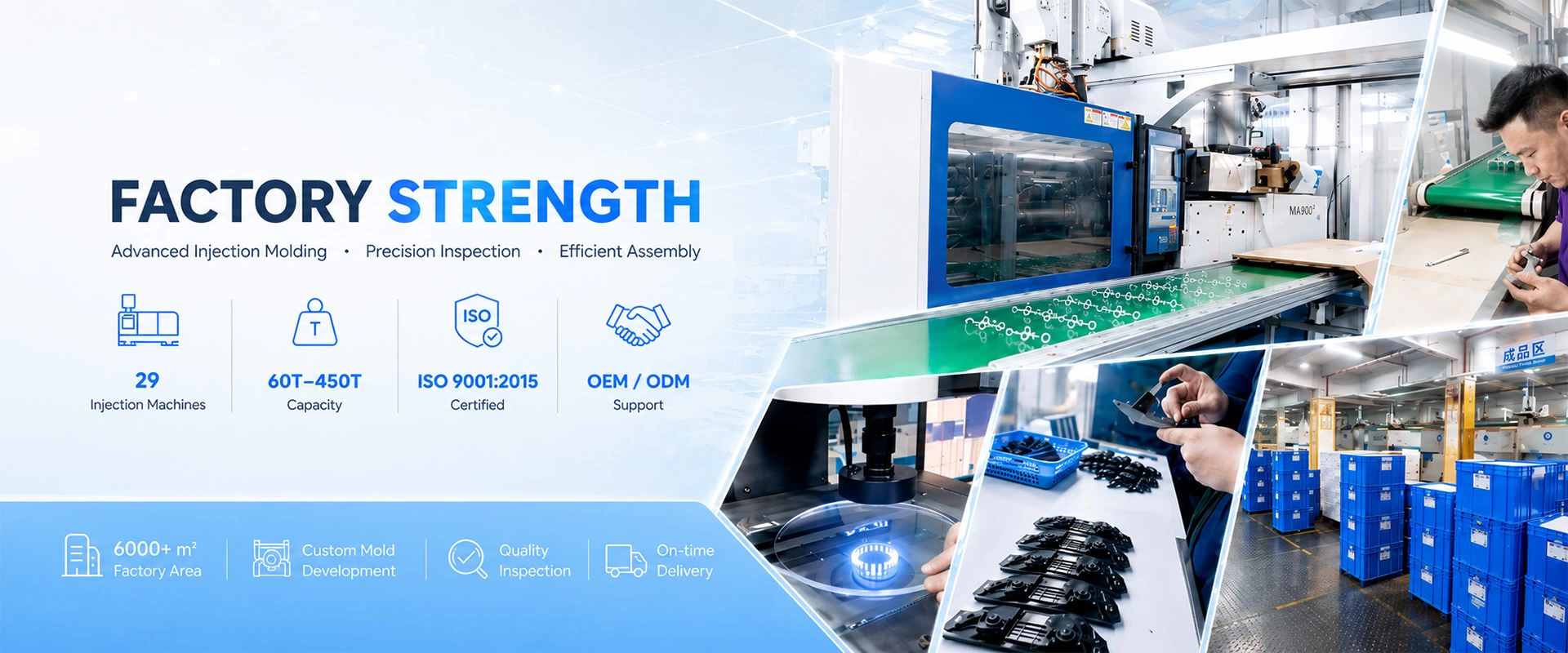
Hengmei builds injection molds in-house at our Qingxi, Dongguan facility, with 29 molding machines from 60 to 450 tons. Send us your 2D drawings, 3D files or samples and we will recommend a steel grade and tooling approach against your volume forecast.
- DFM review and steel recommendation before tooling starts
- Mill certificates and hardness verification as project milestones
- In-house trial molding, dimensional inspection and fit testing
- Electroplating, painting, printing and assembly in one workflow